

Hindu American adolescents are often at the forefront of discussions within Hindu family circles. Parents who migrated from India continuously worry about whether their children will continue to embrace our cultural heritage. Simultaneously, teenagers aged between 13 to 17 are navigating their identities amidst various influences, particularly within the school system.
Many questions arise, not only for these teenagers but also for their Indian parents, as they strive to understand their place in society. Allow me to share a few conversations I’ve had with Hindu American teens who are navigating the challenges of being juniors and seniors in the American school system.
My initial question pertained to the ongoing conflict between Palestine and Israel. My intention was to understand how these teenagers discern right from wrong and make moral judgments.
Teen’s Response: “This is bad and it should stop immediately.”
I followed up with: “Who do you believe is right or wrong in this conflict?”
Teen’s Response: “Certainly, it’s Israel.”
Further Inquiry: “What leads you to that conclusion?”
Teen’s Answer: “Because they have caused harm to innocent people.”
Continuing the discussion, I asked: “Do you know how many Jewish people have been Killed?”
At this point, there was a moment of silence, indicating lack of awareness.
I further probed: “Why do you think the Israeli government is engaging in such actions? What motivates them?”
Again, there was silence in response.
I pressed on: “If you’re unsure, why take a side?”
I shared the beginning of the battle, wherein Hamas, a terrorist organization, attacked Jewish people, resulting in over 1000+ people died. In response, Israel launched an attack on the Palestinian state.
I asked again: Is this was wrong?
Teen Replied: Ofcourse Yes,
I asked the follow-up question: “Can you take a stand and say that what Hamas did should be condemned, and also condemn Israel’s actions equally? Israel should immediately stop killing innocent people who have no affiliation with Hamas.
Teen’s Explanation: “No, we can’t. It’s the prevailing sentiment within the school system. Remaining neutral might be seen as weakness, and our side is based on the sentiment dominating the current discourse.”
As our conversation progressed, I transitioned to the second topic, discussing the Shri Ram Pran Pratishta Program held in India on January 22nd with a group of teenagers. My initial inquiry was directed at their thoughts and feelings regarding this widely celebrated event across India.
The responses from the teenagers varied. While some expressed approval, stating it was a positive decision, others appeared indifferent, showing minimal interest or even a lack of awareness about the program.
Sensing the need to engage them further, I decided to provide visual context by showing them a selection of images sourced from an American news channel. These images aimed to offer a glimpse into the significance and scale of the event, potentially sparking more interest and prompting deeper discussion.”
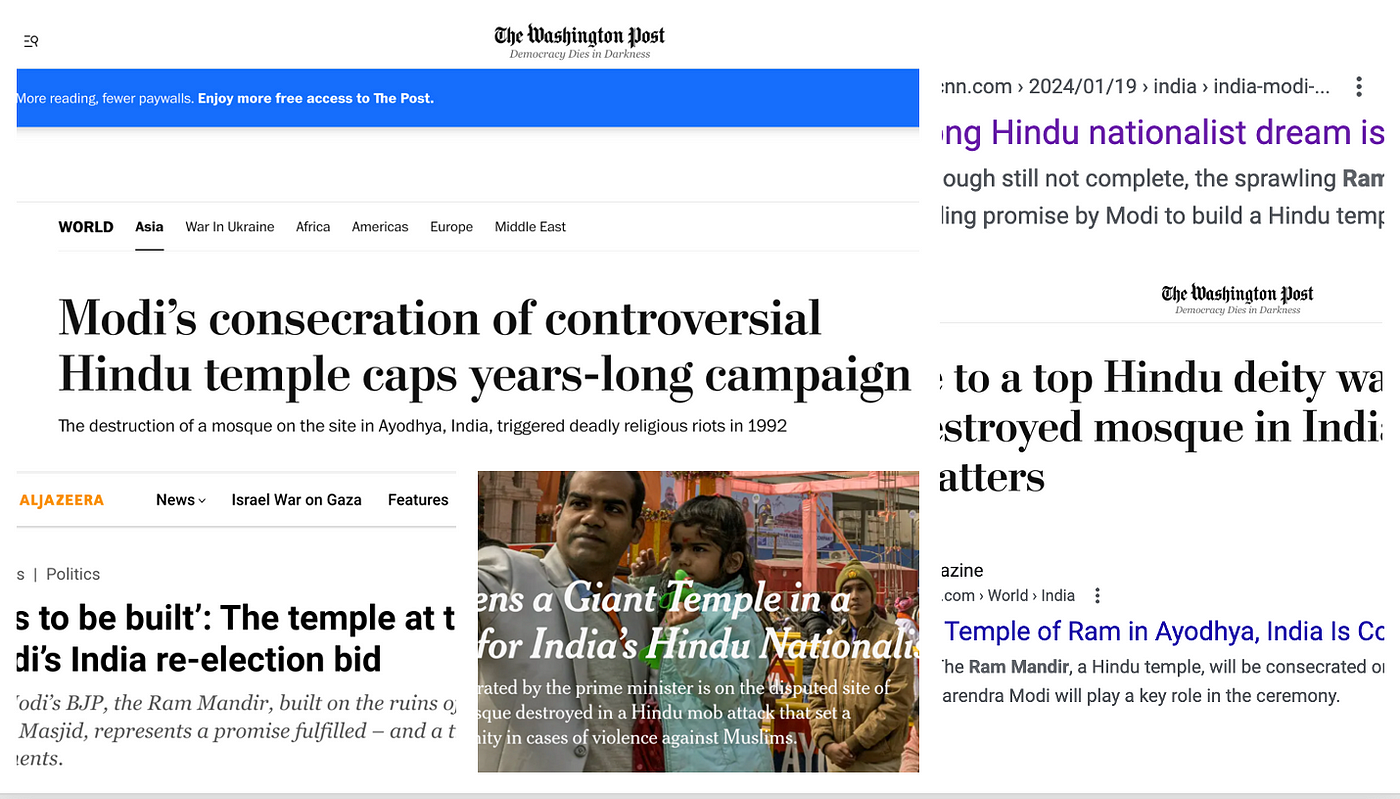
I asked the group for their opinions on the topic at hand.
Their responses varied: some noted that it was done by Hindu nationalists, while others labeled it as controversial and tied to political agendas. Additionally, there was recognition that the structure was built after the destruction of a mosque.
Now, I showed them second visual, the other side of the media and asked them to response:
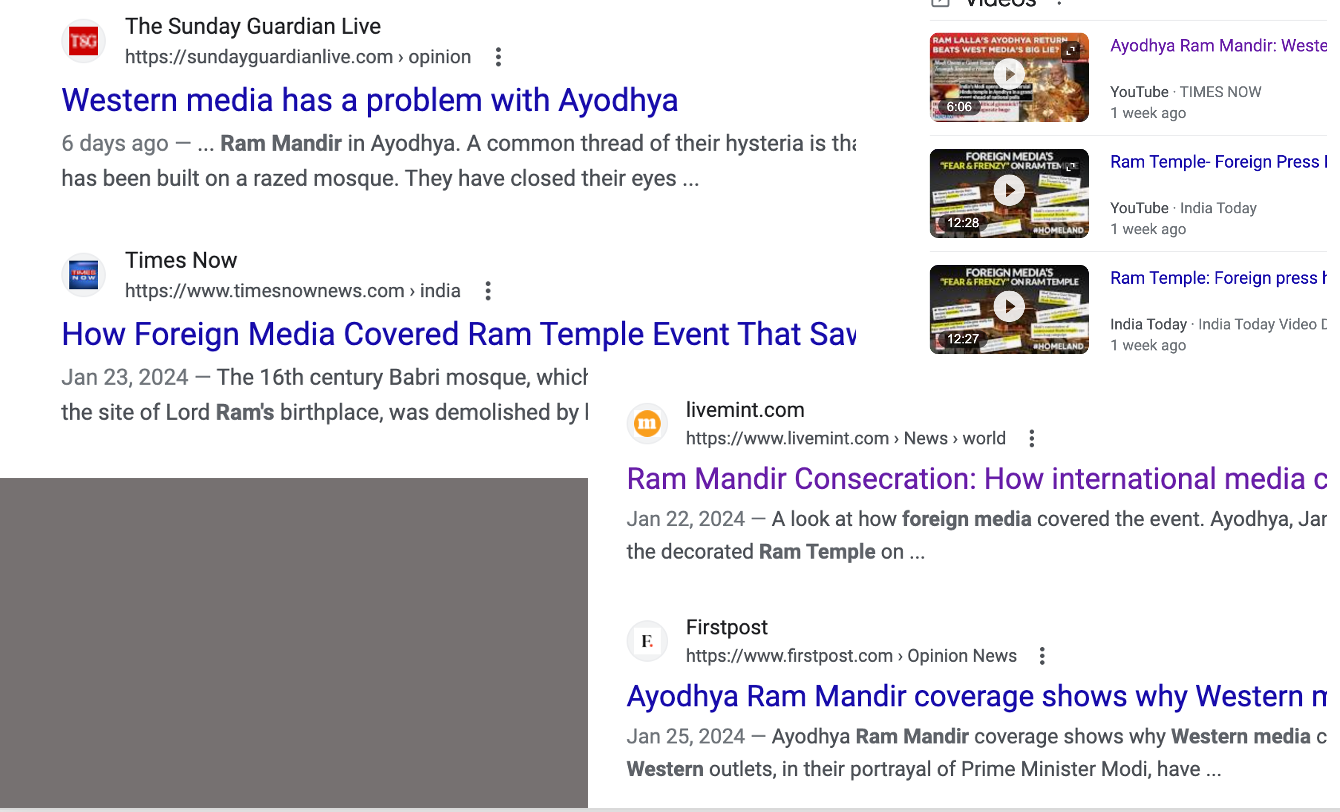
The teenagers responded with varying opinions. Some asserted that Western media is biased, accusing them of making the issue controversial. However, the majority remained silent, which could be interpreted as either a lack of awareness or simply disinterest.
Nonetheless, the topic continues to be part of school discussions. Interestingly, even though the subject is associated with the Hindu community, Hindu children in school show little to no interest in it. Even when the prevailing sentiment is that the temple was built by Hindu nationalists, the huge possibility for them to tend to side with this view.
What I’ve come to understand is that the American school system creating an environment where students may feel hesitant to take a stand without complete knowledge and become sided to the sentiment prevail by majority.
Unfortunately, Hindu children aren’t adequately empowered by their community to confidently form their own opinions. This highlights a gap in preparation within Hindu society for the next generation.
What should Hindu American teenagers do?
1: Critical thinking: It’s crucial to foster critical thinking skills and encourage yourselves to voice their perspectives thoughtfully, even in complex and sensitive matters.
2: Citing Sources: Stress the importance of citing credible sources when sharing information or forming arguments.
3: Fact-Checking: Encourage the practice of fact-checking before sharing or believing information.
4: Source Evaluation: how to critically assess the credibility of media sources.
Ultimately, the trajectory of one’s journey rests in the hands of the individual. However, it’s crucial to recognize that the societal backdrop against which this journey unfolds significantly influences the choices available and the outcomes achievable. If society fails to cultivate an environment rich in opportunities and conducive to personal growth, where individuals can thrive and take pride in their heritage, then it forfeits the right to critique or lament the paths individuals choose.
Therefore, it’s incumbent upon society to not only acknowledge but actively work towards creating an atmosphere where individuals can forge their paths with confidence and pride in their heritage.

 The Hindu Pencil
Leave a comment