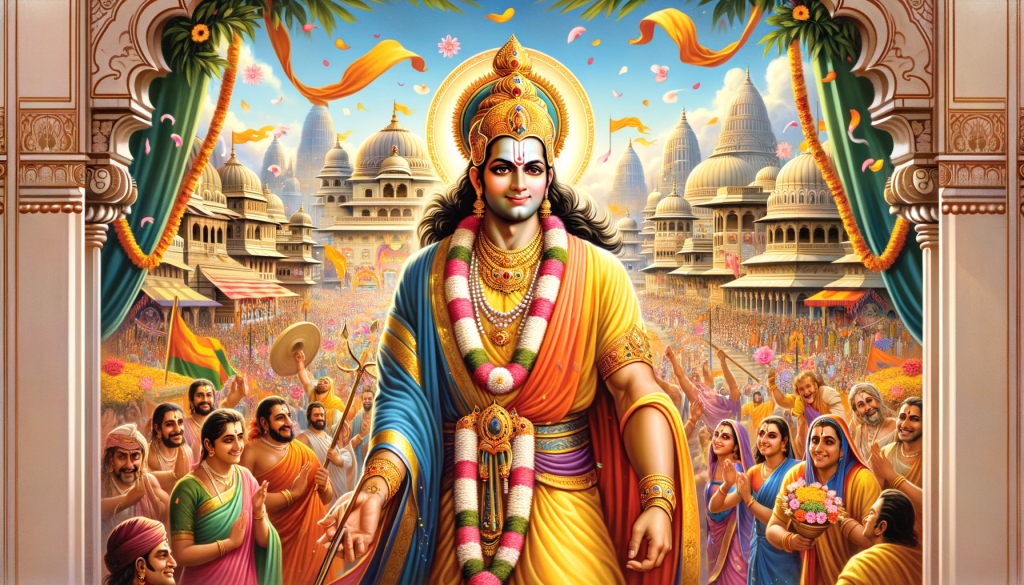
Ram, the name that echoes through the hearts of every Bharatvasi, holds a significance that transcends mere religious beliefs. It symbolizes an embodiment of ideals, an epitome of righteousness, and a cultural anchor for the people of Bharat. The tale of Shri Ram, an incarnation of Lord Vishnu in the Treta Yuga, is not just a religious narrative but a profound cultural heritage that has shaped the collective consciousness of the Bharatiya people for millennia.
The Bhartiya calendar divides time into four yugas, each representing distinct phases in the evolution of human civilization. Ram’s story unfolds in the Treta Yuga, a time of righteousness and virtue. His life, depicted in the epic Ramayana, serves as a guiding light for individuals in their roles as sons, husbands, kings, warriors, and, fundamentally, as human beings. The idea of Shri Ram goes beyond religious boundaries; it embodies a universal moral compass that resonates with the core values of humanity.
The reverence for Ram becomes even more poignant in the context of the historical challenges faced by Bharat. The land has endured waves of invasions and conquests by various forces, such as the British, Mughals, Mongols, and Portuguese, spanning over a millennium. The impact of these invasions was not only political and economic but also cultural and religious. The Mughal era, in particular, Hindu society witnessed the destruction of around 40,000 temples, and the infamous year 1528 marked the cruel demolition of Ram’s temple in Ayodhya by Mughal ruler Babur who ordered his commander Mir Baki to destroy the Ram Temple, and replaced it with a mosque.
The centuries that followed were marked by a sense of loss and longing among the Hindus, as they carried the weight of the destroyed temple in their hearts. The sentiment attached to the Ram temple mirrored the profound connections that Muslims have for Mecca and Christians for the Vatican. It was not merely a physical structure but a sacred space that held the essence of their cultural identity and spiritual beliefs.
The post-independence era witnessed a complex legal battle over the site, starting in 1949 when the idol of Shri Ram was placed in a mosque, leading to its declaration as a disputed area by the Supreme Court of India. Despite gaining independence in 1947, the Hindu community found themselves entangled in legal complexities. The struggle persisted for the next 50+, the Indian Government retreated, seemingly in an attempt to appease the Muslim community, without showing consideration for the sentiments of Hindu society.
The nature of Hindu society during this period was characterized by its commitment to lawful means to resolve the dispute, a testament to the inherent resilience and patience embedded in the culture. However, as the years went by, the patience of the Hindu society reached its limits. The confrontation in 1992, marked by the dismantling of the disputed structure, was not an act of aggression but a manifestation of the latent strength of a society asserting its right to a sacred space without suppressing others.
From 1992 to 2022, the legal battle continued through the High Court and the Supreme Court of India. The Archaeological Survey of India (ASI) played a crucial role, conducting an investigation to unearth historical evidence. Shri K K Muhammed, a Muslim archaeologist, led efforts to reveal proof of temples being destroyed by Mughal rulers, highlighting the historical injustices suffered by the Hindu community. Link to the YouTube video
Finally, on November 9th, 2019, the Supreme Court of India handed over the disputed land to a trust for the construction of the Ram Temple. This momentous decision marked the culmination of a struggle spanning over 500 years. Bhagwan Shri Ram was finally getting his home back, and Hindus were reclaiming not just a physical space but a sense of pride that had been suppressed for centuries.
The journey from 1947 to the declaration in 2019 was a testament to the resilience of a society that had endured oppression for centuries. The construction of the Ram Temple, scheduled for January 2024, carries profound implications for the societal landscape of Bharat. Around 130 million families which is close to almost 400 millions people donated the money to build the Ram Temple. The legal battle, spanning 72 years after independence signifies more than just the physical rebuilding of a temple; it heralds a societal renaissance—a resurgence of cultural pride, historical continuity, and spiritual identity. The oppressed Hindu society, which bore the weight of invasions and subjugation, is now poised to reclaim its stand in the society and assert its place in the cultural tapestry of Bharat.
The significance of the Ram Temple extends beyond religious boundaries; it is a symbol of unity and cultural resurgence. The word Shri Ram itself has the power to bridge gaps and foster a sense of belonging among the diverse communities that make up the tapestry of Bharat. The construction of the temple is an opportunity for reconciliation and collective healing, a chance to move beyond the scars of history towards a shared future.
In essence, the Ram Temple stands as a beacon of hope, not just for Hindus but for all those who seek a harmonious coexistence of diverse cultures and beliefs. The transformative force of this temple lies not only in its architectural magnificence but in its ability to inspire a societal renaissance—a renewal of values, unity, and cultural vibrancy. As the foundations of the temple take shape, so too does the collective spirit of a society that refuses to be defined by its past but aspires to shape its destiny with pride and resilience.
In conclusion, the journey of the Ram Temple—from the destruction in 1528 to the legal battles of the 20th and 21st centuries—captures the essence of a civilization’s resilience, determination, and commitment to justice. The construction of the temple in 2024 is a cultural and spiritual resurgence, signifying the triumph of righteousness over centuries of oppression. The Ram Temple stands as a testament to the enduring spirit of Bharat, a society that rises from the ashes of its history to forge a path of unity, pride, and cultural continuity.


Leave a Reply