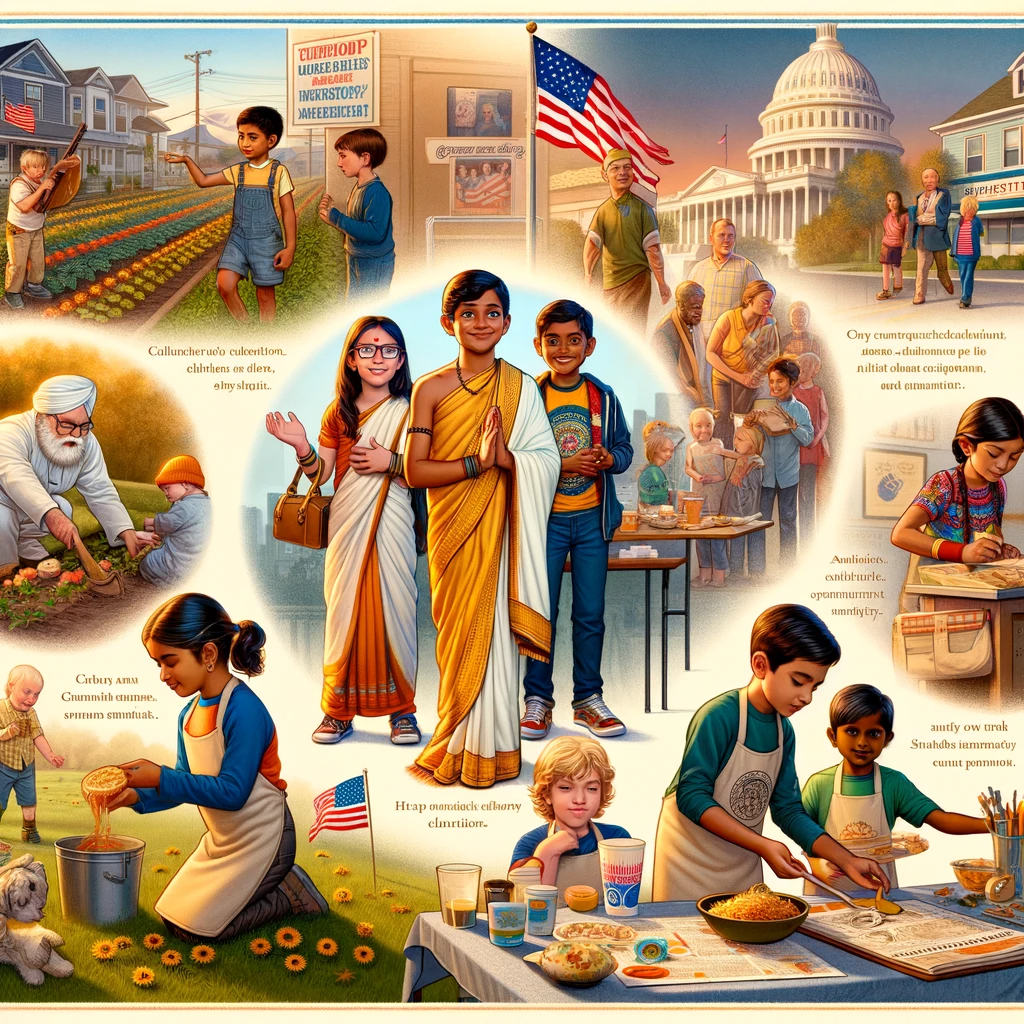
Hindu children frequently find themselves navigating questions of identity and belonging. Do they primarily identify as Hindus, Indians, or do they more accurately consider themselves Americans with Indian roots? These questions are part of their everyday experience. The question of ‘who am I’ has been a persistent and profound concern for Hindu children for many years. The generation which migrated from India did most of their schooling and higher studies in India and for better opportunities for their family came to America. In this whole journey of setting up careers and building a better life for Hindu kids, not much focus was given to understanding the schooling system in America and how the outside environment shaped the lives of Hindu Kids. The expectations of home and outside society, along with an overall lack of emphasis on the importance of self-identity, lead Hindu kids to struggle and be in a constant dilemma to understand ‘who am I’.
Importantly, these identity dilemmas are not unique to Hindu children alone; children from diverse backgrounds, irrespective of their race or faith, often wrestle with similar uncertainties. Thus, navigating the landscape of identity, and finding clarity within this realm of uncertainty, becomes a universal journey that transcends cultural and religious boundaries.
The time has come for a meaningful dialogue that delves into what it means to be a Hindu in America. This long-overdue conversation should ignite introspection about their place in the context of America, the various elements that shape their identity, and how they choose to define themselves in a world that is increasingly diverse and interconnected.
Exploring the Significance of Identity
Many people often contemplate the meaning and importance of having an identity. They may question why we can’t simply view ourselves as members of the human race, transcending all other distinctions. However, in making such a statement, we often overlook a fundamental truth: being human is, in itself, an identity that sets us apart from animals and all other living beings. Each of us possesses a name, which, in essence, is a facet of our identity. Thus, the concept of identity is intrinsic to our existence and extends beyond mere names.
Identity, in essence, is a reminder of our role in society. It’s like a mirror reflecting the distinctive roles we all play within our communities. Just as every individual crafts their own unique persona, our identity is an extension of this self-expression. In light of this, the key is not to shy away from the notion of identity but to embrace it and use the power of language to accurately convey who we are and what we stand for. By understanding our identity and effectively communicating it, we foster deeper connections, build understanding, and promote unity within the diverse structure of human society.
The Melting Pot: Forging America’s Diversity
The United States is often likened to a Melting Pot, a concept that reflects the remarkable way in which the thirteen colonies, from the very inception of the nation, have drawn forth the finest attributes from each of them. These colonies brought their unique perspectives and contributions, which were seamlessly assimilated into a collective identity that worked harmoniously for the benefit of all.
Each colony functioned as an ambassador of its distinct culture and heritage, enriching the American tapestry. Yet, in this process, they willingly relinquished certain elements that did not harmonize with the broader vision of forging a united America.
For instance, they retained their own languages, but wisely chose to embrace English as the common tongue, thereby fostering effective communication and unity. They passionately upheld the ideal of religious freedom, yet for the sake of a shared American destiny, they courageously parted ways with the protective embrace of the British Crown.
In the grand narrative of the United States, the colonies exemplified the essence of cultural diversity and the spirit of compromise, offering their unique gifts while making the collective prosperity and unity of America their highest priority.
Who is Hindu
At this juncture, one of the most challenging words to define and describe is ‘Hindu.’ The complexity of this term arises from the fact that people who have been part of this heritage for around 5000 years never attempted to encapsulate it within a single label. Their focus has consistently centered on the well-being of all living beings, encompassing animals, plants, and everything imbued with life. Consequently, ‘Hindu’ wasn’t originally a part of their lexicon. While various narratives exist about the word’s origins, a common theme prevails: those who adhere to dharmic values, see every human as an integral part of the universal spirit (Brahman), and view the world as one family can be considered Hindu.
The concept of the number of gods, the pursuit of truth through different paths, and the practice of four different yogas (karma, bhakti, gyana, and raja) are common themes across all Dharmic societies. This diversity is what every human seeks – the flexibility to choose the path that aligns best with their individual life’s purpose.
Furthermore, the beauty of embracing Hindu system lies in the recognition that all adherents of dharmic values are inherently seekers. They interpret the past, present, and future through their individual understandings, abstaining from imposing their beliefs on others. Instead, their primary connection with the broader society stems from the sharing of their experiences and insights.
The term ‘Hindu’ represents a profound form of secularism. It embodies the idea of a neutral and impartial stance when it comes to matters of connection with divinity or finding the path, allowing for a multitude of perspectives in our diverse society. It’s worth noting that the word ‘secular’ is often used in the context of the state, government, or society, signifying a lack of alignment with any specific religion or religious belief. ‘Hindu’ goes beyond mere religiosity; it’s more like a journey of self-discovery that empowers individuals to explore their own paths and beliefs.
Embracing the Term ‘Hindu’: Identity, Diversity, and Definition
After reading the above, some might question why we should call ourselves ‘Hindu’ when it allows us to choose any path, and we could name it anything we wish. Indeed, that’s a valid point, and if the world understood it that way, it might suffice. However, today’s world is divided into numerous societies and faiths, each attempting to define and share its value system. We may follow different paths, engage in diverse practices, or uphold various dharmic values, but the world often perceives these under the umbrella of Hinduism or the Hindu religion.
So, instead of internal discord, the first step is to accept the term ‘Hindu’. Just as we accept our names and family identities as aspects of our personal identity recognized by the world, we should also embrace the culture, heritage, and value system acknowledged by society, i.e. ‘Hindu’.
In the words of Sir Charles Norton Edgecumbe Eliot, ‘The Hindu has an extraordinary power of combining dogma and free thought, uniformity and variety. Here, the utmost latitude of information is allowed, and throughout history, Hindus have been devoted to speculation’. This means that throughout history, Hindu culture and philosophy have encouraged and valued deep thinking, inquiry, and intellectual exploration. It suggests that Hindu tradition allows one to engage in philosophical and speculative thought, seeking to understand the nature of reality, the self, and the universe. This openness to questioning, reflection, and philosophical exploration is considered a significant aspect of Hinduism’s rich intellectual heritage.
Proudly Hindu, Proudly American
I could be a child born in America, or an immigrant who has arrived from India. I might speak Gujarati more fluently than English, or I could come from a Telugu-speaking family that primarily communicates in English. I might even be someone who enjoys performing Bhangra dances and is a fluent Hindi speaker. Some of these facets play a role in defining who I am.
However, what truly deepens my sense of self is my identity as a ‘Hindu’. This one word is what defines my character. But that doesn’t stop or hinder my utmost commitment which lies in my responsibility toward America. My life’s purpose revolves around seeking what is in the best interest of America and its people, and every decision I make is guided by this principle. I do not carry a dual identity as an American and a Hindu. I have one identity in the American melting pot, and that is ‘Hindu American’.
Everything I’ve learned from my rich Hindu heritage inspires me to contribute to the diverse tapestry of America. Everything that I am today is the contribution of both. This is the identity that I carried and something which every hindu should be proud of. This identity teaches me to serve the people of America. It teaches that my heritage never seeks to dominate anyone, but wherever it takes root, it merges with the local society and contributes, just as we would serve our own family members.
Confront Fear or Voice It Out
Choosing between living in fear or confronting or embracing it is a decision each individual must make. It’s essential to first believe in it and possess the understanding to communicate it with its power to everyone. The time has come to remove fear from our minds. There will always be forces that try to convince you to go against your Hindu identity. They want to mislead you into thinking that being Hindu means something else. It’s time for you to stand up and speak about this rich heritage and accept the identity of being a Hindu American. Just like every immigrant, Americans proudly live with their own cultural identities, and Hindus should equally embrace and live with pride in their heritage.

 The Hindu Pencil
Leave a comment